


Built For Real: Shaping Ideas While Preserving Vision
Client Collaboration & Creative Evolution
Every great project begins with an idea. Sometimes it arrives as a detailed design package. Other times it starts as a sketch, a conversation, or simply a vision of what could be.
At Entech, our role is not to replace that vision. It is to strengthen it.
Collaboration is one of the most valuable parts of our process. By combining engineering expertise, fabrication experience, and practical problem-solving with our clients' creative goals, we help transform concepts into solutions that are buildable, maintainable, and true to the original intent. Early collaboration doesn't just improve the design. It reduces risk, minimizes costly redesigns, and creates a smoother path from concept to installation.
This month, Built for Real explores how collaboration, trust, and open communication allow ideas to evolve without losing what made them special in the first place.
Listening Before Designing

Successful collaboration begins with listening. Before engineering calculations begin or fabrication plans are developed, the team works to understand what the client is truly trying to accomplish. Sometimes the most important part of a project is not the exact dimensions or materials. It is the experience, story, or emotion the finished piece is intended to create.
Understanding those priorities allows Entech to make informed recommendations throughout the project while protecting what matters most.
Rather than asking, "Can we build this?"
The conversation becomes, "How can we build this in the smartest possible way?"
Executive Director Justin Stehr believes the strongest partnerships are built long before fabrication begins.
"A successful client partnership is built on trust, open communication, and a shared commitment to the success of the project." Justin explains that early collaboration creates opportunities to align expectations, identify challenges before they become problems, and make informed decisions together. "The earlier that collaboration begins, the better the outcome."
"Yes, And..."
One of the guiding principles behind successful collaboration is a simple mindset:
"Yes, and..."
Instead of approaching challenges by identifying what cannot be done, Entech works to identify what can.
A design may require adjustments to improve structural performance. A fabrication process may need refinement. Materials may change. Components may become modular. Installation methods may evolve. But throughout every discussion, the objective remains the same: preserve the creative vision while improving the final solution.
Justin describes that approach this way: "The intent is never to move away from the original vision."
When changes become necessary, the conversation centers around understanding what matters most to the client and why. "Rather than focusing on what can't be done, we work together to preserve the experience and design intent while developing a solution that can be built, operated, and maintained successfully." The best collaborative projects do not become compromises. They become stronger because multiple perspectives helped shape them.

Building Trust Through Transparency
Creative collaboration depends on trust. Clients trust Entech to protect their vision while offering honest technical guidance. That trust is built through open communication, thoughtful recommendations, and transparency throughout every phase of the project.
Senior Project Manager Eric Roehl notes that many of these conversations come down to helping clients understand the relationship between design decisions and project realities.
"Ultimately for the creative clients, what they understand best are the cost impacts." That often leads to collaborative discussions about how to preserve the vision while staying within budget. "We can do what you have in mind, but the cost will be much more than your budget. However, if you would not mind this change, then we can meet your budget."
Eric also points out that installation considerations are frequently overlooked early in the process. "While what they have in mind is perfectly simple and straight forward from the design and fabrication side, we now have to get this into place and installed. This installation aspect greatly impacts the design early on."
By discussing these realities openly, the team helps clients make informed decisions that support both creativity and successful execution.
Better Together
No single department shapes a project alone.
Engineering provides technical solutions. Fabrication brings practical manufacturing expertise. Project management keeps communication flowing between teams and clients. Installation provides valuable field insight. Leadership helps balance creative ambition with practical execution.
When these perspectives come together early, projects become more efficient, more reliable, and often more innovative than originally imagined. That collaborative mindset extends beyond Entech's walls. Clients become part of the process, allowing every project to benefit from shared expertise and mutual trust.
For Eric, one of the most rewarding moments comes at the very end of a project. "By the time the piece is installed and the looks and works as good, or better, than the client expected, then we have done our job."
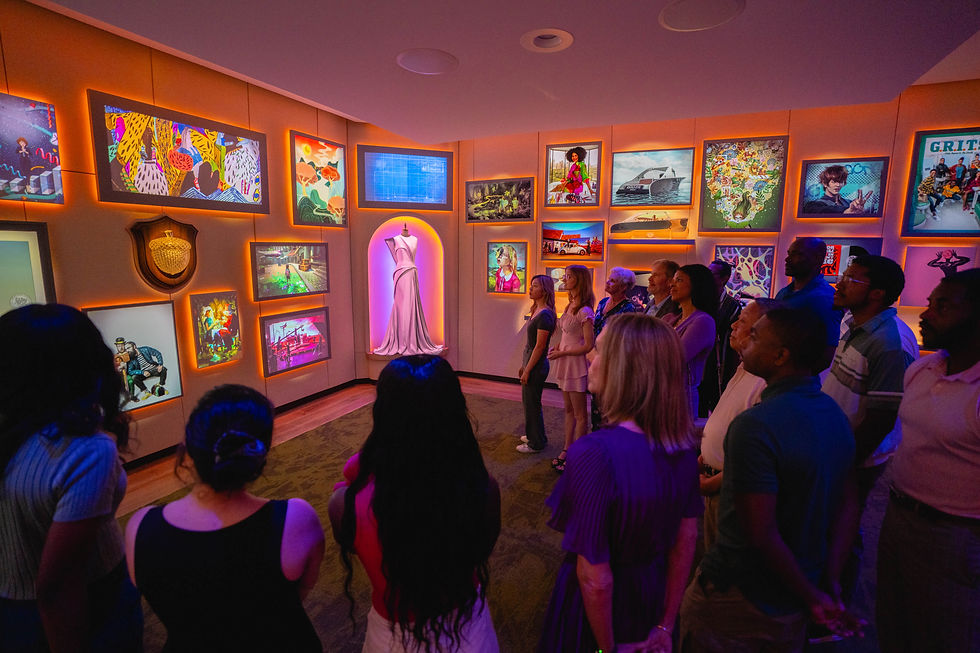
He recalls the completed SCADstory project in Atlanta, where Entech partnered with BRC Imagination Arts to fabricate and install custom show elements. "When the president of the school saw the finished project, she was amazed that we made a doorway appear in a 'solid' wall with a piece of glowing artwork 'suspended' in mid air."
Those moments are a reminder that successful collaboration is measured not only by the finished product, but by the experience it creates.
The strongest projects are rarely the result of one great idea - They are the result of many great conversations. By listening carefully, communicating openly, and working alongside our clients from concept through completion, Entech helps shape ideas into solutions that honor the original vision while preparing them for the real world.
Because the best collaboration doesn't change the vision. It gives it the structure, reliability, and confidence to become reality.


Comments